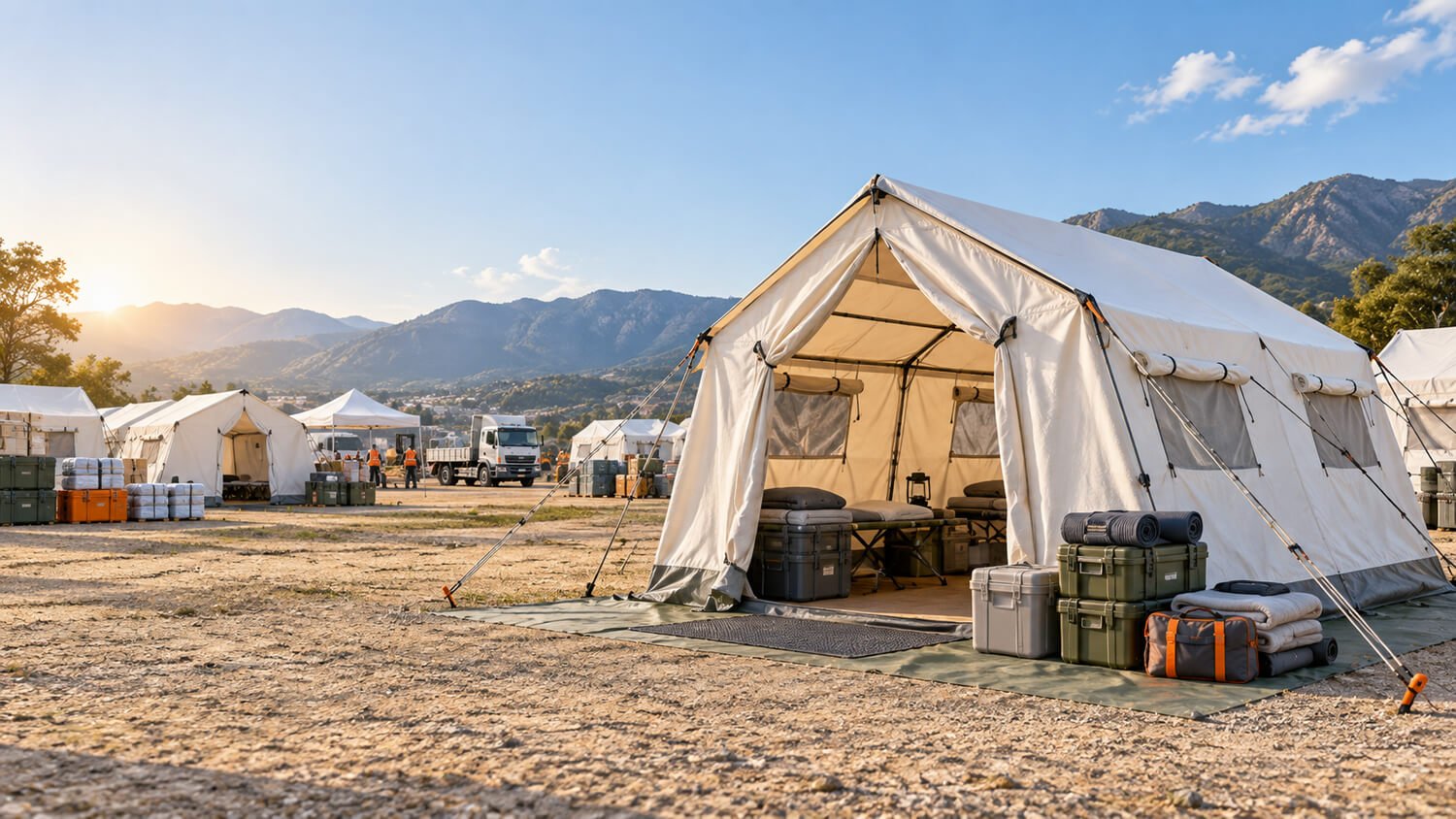
Tents for rescure supplies are temporary structures made to protect displaced families, rescue teams, medical workers, and emergency materials. A suitable rescue tent provides safe covered space, weather protection, ventilation, privacy, and secure anchoring. B2B buyers should choose the model according to climate, user capacity, terrain, service period, transport limits, and applicable safety requirements.
An emergency shelter is much more than fabric stretched over poles. It may become a family’s living space, a field clinic, a relief warehouse, a registration point, or a temporary command center. If the design is wrong, users may face heat, cold, water entry, poor airflow, limited privacy, or unsafe evacuation.
Common buyers include:
- Humanitarian relief organizations
- Government emergency agencies
- Military and civil defense departments
- Disaster-response contractors
- Medical suppliers
- Mining and construction companies
- Shelter and camping distributors
- International procurement companies
The first buying decision is the tent’s function. A family shelter needs privacy and daily living space. A field clinic requires workflow, light, cleaning access, and separate areas. A warehouse tent needs clear internal space and secure access. A mobile rescue team may place greater value on low weight and fast assembly.
UNHCR describes shelter as a way to protect displaced people, not merely as a physical structure. Its guidance calls for appropriate covered living space, safety, and access to essential services. Buyers can review the official UNHCR emergency shelter guidance when preparing project requirements.
Emergency Shelter Needs Assessment
A strong procurement project begins with conditions on the ground. Choosing a tent from a picture or price list isn’t enough. The buyer must first define who will use it, where it will be installed, and how long it should remain in service.
Start with household or team size. A product described as a “family tent” may serve four, five, or more people, depending on its floor area and the project standard. State the required number of occupants and the usable covered area in the purchase specification.
Next, review the local environment:
- Expected temperature range
- Rainfall and flood risk
- Wind speed and direction
- Snow or roof-loading conditions
- Soil type and anchoring limits
- Sun and ultraviolet exposure
- Insect activity
- Drainage and standing-water risk
- Distance from roads and storage hubs
The intended service period also matters. A compact rapid-response shelter may work for several nights. It may not suit a family living on the same site for months. Longer use usually requires better fabrics, replaceable components, stronger frames, improved ventilation, and more space for household activities.
Cultural needs can influence door position, internal partitions, window coverage, and cooking arrangements. Gender, age, disability, and family structure should be included in the review. Older people may need easier entry. Wheelchair users may need wider doors and smoother access. Children require safe fixing points and fewer exposed sharp parts.
Finally, study transport and installation capacity. A remote response may depend on small vehicles or manual carrying. In that case, packed weight and module size can be just as important as finished dimensions.
A clear needs assessment lets the manufacturer propose a suitable configuration instead of making costly assumptions.
Emergency Tent Type Comparison
Emergency tents serve different tasks. No single design performs equally well as a family shelter, medical facility, distribution center, and long-term warehouse. Buyers should separate these uses before comparing quotations.
| Tent type | Main application | Typical advantages | Key buying concern |
|---|---|---|---|
| Family relief tent | Temporary household shelter | Privacy, vestibules, ventilation, living space | Capacity and climate suitability |
| Rapid-deployment tent | First response and mobile teams | Fast setup and compact transport | Stability and service life |
| Medical tent | Triage, treatment, and isolation | Controlled access and flexible interior | Cleaning, airflow, and zoning |
| Command tent | Coordination and communications | Open layout and cable access | Power, lighting, and weather protection |
| Warehouse tent | Relief-stock storage | Large clear span and high capacity | Structural loading and security |
| Winterized tent | Cold-weather accommodation | Liner, insulation, floor protection | Heating safety and condensation |
| Multipurpose tent | Registration, dining, education, or meetings | Adaptable internal space | Occupancy, exits, and ventilation |
Family tents often use a double-layer design. The outer layer sheds weather, while the inner layer supports comfort, insect protection, and privacy. Vestibules offer useful space for shoes, tools, or household goods without reducing the main sleeping area.
Rapid-deployment shelters may use folding, inflatable, or connected frame systems. Fast setup is valuable, but the buyer should still examine repair needs, pump requirements, spare parts, and performance after repeated use.
Medical shelters require special planning. The layout may need separate clean and contaminated zones, washable inner surfaces, screened ventilation, lighting, electrical access, and controlled entrances. These requirements should come from qualified medical planners.
A product’s name doesn’t prove its suitability. Ask for drawings, usable floor area, packed data, material specifications, assembly time, recommended crew size, and test evidence.
Tent Fabric and Frame Specifications
Fabric choice affects weight, water resistance, airflow, strength, fire behavior, and useful life. B2B specifications should describe performance rather than relying only on general material names.
Polycotton canvas can provide good breathability and a more comfortable indoor climate. However, its weight, treatment, weave, and resistance to moisture or biological growth must be controlled. Coated polyester may be lighter and easier to clean. Woven polyethylene can work well for groundsheets, mud flaps, and some outer covers.
Important fabric parameters include:
- Fiber composition
- Finished weight in grams per square meter
- Tensile strength
- Tear resistance
- Water resistance
- UV resistance
- Rot resistance
- Flame performance
- Colorfastness
- Water-vapor permeability
- Coating adhesion
A heavier fabric isn’t always stronger. Fiber quality, weave, coating, and finishing also influence performance. Buyers should compare test results from representative production materials.
Frames may use galvanized steel, aluminum, or another engineered system. Steel provides strength and familiar repair methods, though it adds weight. Aluminum lowers weight and resists corrosion well, but its alloy, tube wall, joints, and repair plan require careful review.
Poles should connect securely without producing dangerous sharp edges. Pegs must match the soil. Soft ground may need longer stakes or deadman anchors. Hard ground may require strong steel pegs. Sand calls for wider anchoring systems.
Seams are common failure points. High-load seams should use suitable thread, controlled stitch density, reinforcement, and waterproof construction. Groundsheets benefit from raised edges and sealed joints that limit water entry.
Request a component drawing for poles, pegs, ropes, tensioners, fasteners, and connectors. A missing low-cost fitting can prevent an entire shelter from being installed.
Weather Resistance and Climate Adaptation
Emergency shelters face demanding conditions. Yet “all-weather” is too broad to be a useful specification. Buyers should define the actual temperature, wind, rain, snow, sun, and humidity expected at the deployment site.
Rain protection begins with fabric and seam performance. It also depends on roof slope, tension, overhangs, drainage, and ground preparation. Water can enter a waterproof tent when the structure sags or runoff flows beneath the floor.
Wind resistance depends on the complete system:
- Frame geometry
- Pole strength
- Guy-line layout
- Peg design
- Fabric tension
- Connection strength
- Ground conditions
- Installation quality
A laboratory or controlled field test can assess the product, but site teams must still install it correctly. Loose ropes, weak soil, and missing stakes can reduce performance sharply.
The current UNHCR eco-design family-tent specification describes a total floor area of 23 square meters. It also gives detailed material, testing, packing, marking, and repair requirements. Buyers can examine the official UNHCR family-tent specification as a valuable technical benchmark.
Hot climates need shade, cross-ventilation, screened openings, and suitable roof layers. Cold regions need insulation, protected floors, controlled ventilation, and safe heating arrangements. In humid climates, breathable construction may reduce condensation. Dusty areas need closable vents and protected openings.
Never add a heater without a safe system designed for that shelter. The stove, flue, heat-resistant sleeve, clearance, ventilation, and user instructions must work together. Local fire and carbon-monoxide rules also apply.
Living Space, Privacy, and Accessibility
Floor area affects health, comfort, privacy, and daily life. A shelter must allow users to sleep, dress, store belongings, care for children, and move safely.
The Sphere standards state that people should have safe and adequate living space for essential household activities. Its related guidance often uses 3.5 square meters of covered living space per person as a key reference. Context may require more space, especially in cold weather or during long occupancy. See the Sphere Handbook for the complete shelter framework.
UNHCR’s current family-tent specification provides 16 square meters of main floor area and two 3.5-square-meter vestibules. This creates a total of 23 square meters for a family of five. Buyers shouldn’t copy those dimensions blindly, but they provide a recognized comparison point.
Useful living-space features include:
- Full or partial internal partitions
- Two entry points
- Covered vestibules
- Ventilated windows
- Insect screens
- Internal storage loops
- Raised groundsheet edges
- Secure privacy flaps
- Adequate standing height
- Clear emergency exits
Accessibility must be considered early. A narrow step, high threshold, or small door may block a wheelchair. People with limited strength may struggle with heavy flaps and tight closures. High-contrast zipper pulls, wide openings, gentle access slopes, and clear paths can improve use.
Privacy is also linked to tent placement. Entrances shouldn’t directly face another family’s doorway when the site allows another arrangement. Lighting, washing areas, and toilets must be planned with protection in mind.
A good B2B proposal should provide dimensioned drawings. These help shelter specialists review occupancy, circulation, door clearance, and internal zoning before approving the sample.
Fire Safety and Settlement Planning
Fire safety can’t be solved by tent fabric alone. Flame-resistant material may slow ignition or flame spread, but it doesn’t make a shelter fireproof. Safe settlement design, user education, cooking control, and access for emergency teams remain essential.
The buyer should define applicable flame-performance requirements. Test reports must identify the standard, laboratory, sample, test date, and result. A report for one fabric doesn’t automatically cover a complete tent or later production batch.
Basic fire-risk controls include:
- Safe spacing between shelters
- Planned firebreaks
- Marked escape routes
- Controlled cooking areas
- Suitable fire points
- Clear vehicle access
- Safe fuel storage
- User training
- Emergency contact procedures
- Regular site inspections
Cooking inside an ordinary family tent creates serious danger. Heat, open flames, hot oil, fuel leaks, and smoke can cause fire or poisoning. Unless a tent and appliance have been designed for that use, cooking should take place in a designated safe area.
Site drainage is another safety issue. Avoid low ground, unstable slopes, dry riverbeds, contaminated land, and paths used by moving vehicles. Grade the site so water flows away from shelters. Keep guy lines visible to reduce trip hazards.
Settlement planners should also protect access to water, sanitation, health care, registration, and distribution points. A technically sound tent on a poorly planned site still creates problems.
Soft CTA: Ask the manufacturer for material reports, a complete assembly drawing, packed dimensions, and a sample-testing plan before approving your tender specification.
Assembly Tools and Shelter Accessories
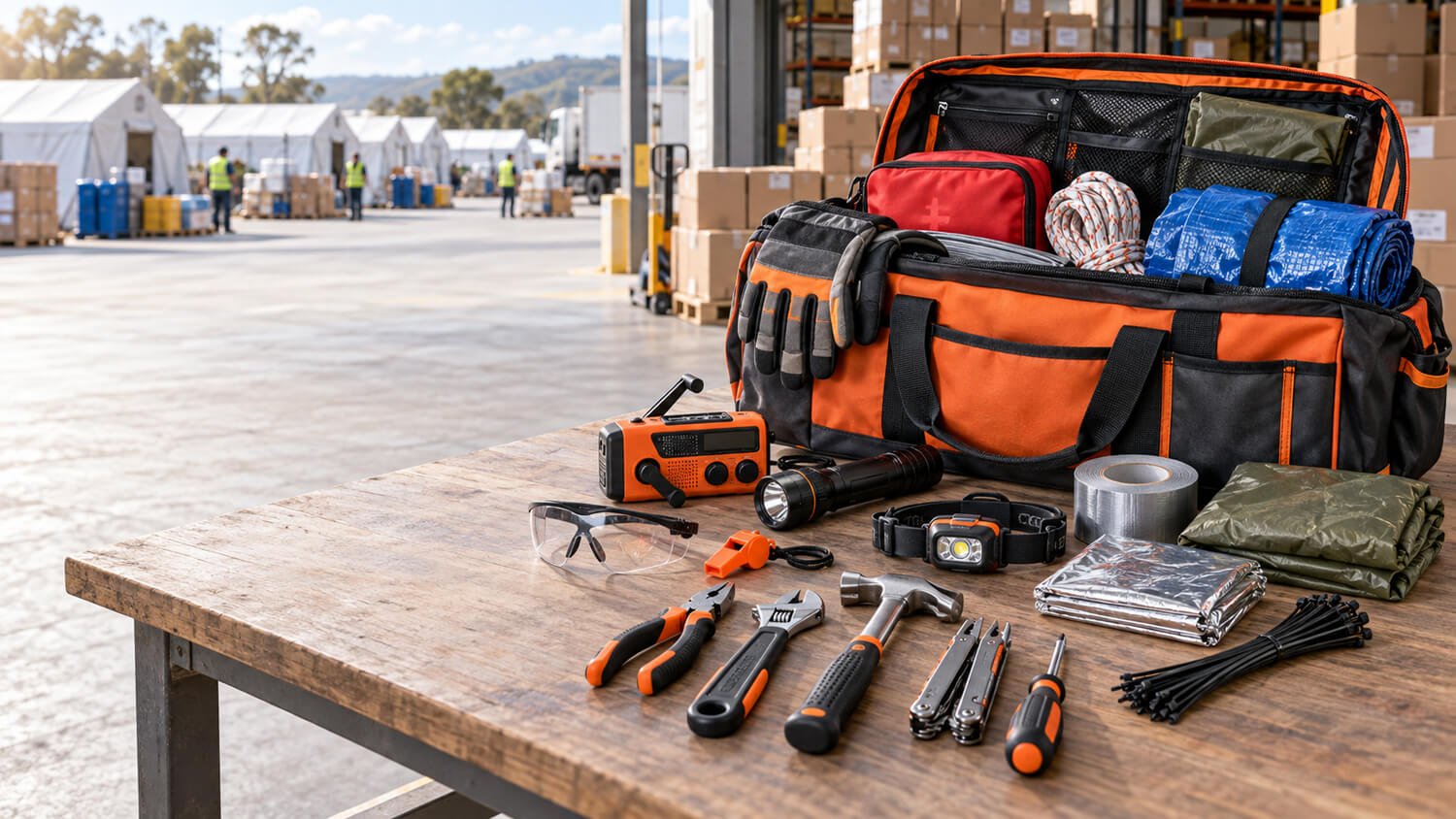
A shelter that can’t be installed with available tools isn’t ready for emergency use. Every packed unit should contain a verified contents list, clear instructions, and the required accessories.
A standard accessory set may include:
- Structural poles
- Door and side poles
- Ground pegs
- Guy ropes
- Rope tensioners
- Hammer or mallet
- Repair fabric
- Sewing needle and thread
- Spare cord
- Carrying bags
- Assembly instructions
- Component checklist
Instructions should use drawings and short steps. They should show pole positions, peg angles, guy-line order, fabric orientation, and final tensioning. Text should be translated for the destination market when required.
Assembly time should be tested with the proposed crew. A highly trained factory team isn’t a fair measure of field performance. Run at least one trial with people who haven’t seen the product before. Record setup time, mistakes, missing information, and tool needs.
Repairability also matters. Small tears, damaged ropes, and lost pins shouldn’t force the buyer to replace the whole tent. Provide compatible patches, thread, cord, fasteners, and spare-part codes. The manual should explain safe minor repairs and when a damaged shelter must be removed from use.
Optional modules may include:
- Winter liners
- Insulated floor mats
- Shade covers
- Mosquito nets
- Solar lighting
- Internal partitions
- Storage organizers
- Accessibility ramps
- Extra anchoring equipment
Accessories must remain compatible with the approved tent. A heater sleeve, for example, must match the planned flue system and heat requirement. Unapproved alterations can weaken weather or fire performance.
Manufacturing Quality and Performance Testing
Quality control should follow the product from raw material to packed shelter. Final inspection alone may not reveal weak coatings, incorrect fiber blends, or poor steel treatment.
A practical factory control plan includes:
| Production stage | Main checks | Typical evidence |
|---|---|---|
| Incoming fabric | Weight, composition, color, damage, test status | Material inspection report |
| Frame production | Tube size, wall thickness, coating, joints | Dimensional and coating record |
| Cutting | Panel size, grain direction, identification | Cutting control sheet |
| Sewing | Stitching, reinforcement, seam direction | In-process inspection |
| Assembly trial | Fit, completeness, setup, stability | Trial report and photographs |
| Water test | Roof, seams, openings, groundsheet | Leakage test record |
| Final inspection | Workmanship, markings, accessories, packing | Final inspection report |
| Shipment release | Quantity, cartons, batch data, documents | Release authorization |
Material testing may cover tensile strength, tear resistance, water resistance, flame performance, UV exposure, and color stability. Frame checks may include dimensions, corrosion protection, fit, and load-related requirements.
Finished tents should be pitched during production checks. This reveals mismatched panels, wrong pole lengths, zipper problems, poor tension, and missing accessories. A packed tent can look perfect while still being impossible to assemble.
Traceability links raw materials and components to a production batch. Each tent should carry a durable manufacturer label with the batch reference and production date. This supports investigation, spare-part supply, and targeted corrective action.
A buyer should approve a sealed reference sample before production. The manufacturer can then compare fabric, color, dimensions, construction, labels, accessories, and packaging against one agreed standard.
OEM and ODM Emergency Tent Production
OEM production lets buyers adapt standard shelters to a brand, contract, or market. Custom options may include color, printed markings, bag design, labels, inner partitions, doors, windows, ventilation, accessories, and packaging.
A controlled OEM process normally follows these steps:
- Application and site review
- Technical requirement confirmation
- Preliminary drawing
- Material selection
- Cost and MOQ review
- Prototype production
- Assembly and performance checks
- Buyer sample approval
- Artwork approval
- Mass production
- Final inspection
ODM work goes further. It may involve a new frame, different geometry, custom connector, modular expansion system, or special medical layout. New structural designs require engineering review and suitable validation. Buyers should agree on tooling ownership, drawing control, testing cost, and design rights before development.
Logo printing must not weaken the tent fabric. Ink or transfer systems should remain flexible, weather-resistant, and compatible with the base material. The buyer should approve color, size, location, and durability.
Minimum order quantities depend on the requested changes. Standard colors and existing structures usually support smaller orders. Custom-dyed fabric, unique poles, printed carry bags, or molded fittings may require higher volumes.
From a manufacturing viewpoint, uncontrolled revisions create the greatest delay. Use one specification version and one artwork register. Written approval should cover every panel, marking, accessory bag, instruction sheet, and export carton.
Avoid claiming compliance based on appearance. A tent that resembles a recognized humanitarian model hasn’t necessarily passed the same tests. Request product-specific evidence.
Bulk Purchasing and Export Logistics
Emergency tents are bulky products. Packed dimensions, gross weight, loading method, and warehouse plans affect total cost as much as the unit price.
UNHCR’s eco-design family-tent specification gives an approximate packed weight of 49–53 kilograms and a packed volume of about 0.23–0.25 cubic meters. These values apply to that specified model. Other designs may differ widely.
A complete B2B inquiry should include:
- Tent application
- Required capacity
- Destination country
- Climate and terrain
- Performance requirements
- Order quantity
- Branding needs
- Packaging instructions
- Inspection plan
- Required delivery date
- Destination port
- Preferred Incoterm
Ask the supplier for unit price, sample cost, tooling charges, production lead time, packed data, container estimate, warranty, spare-part availability, and document list.
A lower unit price can create a higher landed cost. Oversized packing wastes container space. Weak bags increase handling damage. Missing labels cause distribution delays. Heavy one-piece packages may also require more workers at the destination.
Pre-shipment inspection should include random assembly tests. Don’t only count packages. Verify that matched poles, ropes, pegs, instructions, and repair parts are present.
Lead time should include sample approval, material booking, testing, production, inspection, and transport. Buyers preparing for seasonal storms should place orders well before demand peaks.
Storage, Maintenance, and Replacement
Correct storage protects the buyer’s investment and keeps shelters ready for rapid deployment. Damp, hot, poorly ventilated warehouses can damage fabric, metal components, coatings, cartons, and printed instructions.
UNHCR’s current specification gives its family tent a minimum shelf life of five years under normal dry, clean, and ventilated warehouse conditions. It advises keeping tents off the ground and storing them on pallets or racks.
A warehouse program should include:
- Batch and production-date records
- Routine package inspections
- Moisture and pest checks
- Pallet-condition reviews
- Stock rotation
- Random accessory counts
- Periodic assembly trials
- Repair-kit inventory
- Clear quarantine procedures
After deployment, tents should be cleaned according to the approved care method and dried completely before repacking. Packing damp fabric can lead to odor, staining, corrosion, or biological growth.
Inspect roof panels, seams, zippers, screens, groundsheets, poles, joints, ropes, pegs, and labels. Replace small parts early. A missing rope tensioner may seem minor in the warehouse but become a serious field problem.
Set clear removal criteria. Severe fabric weakness, damaged structural parts, failed fire performance, or repeated leakage may make repair unsuitable. Don’t send unsafe tents back into stock merely because they still look usable.
Maintenance records also help future purchasing. Frequent failures may show that the fabric, peg type, zipper, or packing method doesn’t match field conditions. Feed this evidence into the next product revision.
Frequently Asked Questions
How many people can one emergency family tent support?
Capacity depends on usable floor space and project standards. A common humanitarian family tent has 16 square meters of main living area plus vestibules and is designed for five people. Buyers should verify local requirements.
What material is suitable for a rescue tent?
Polycotton, coated polyester, and polyethylene can all serve useful roles. The correct choice depends on climate, weight, airflow, strength, cost, and service life. Performance tests matter more than the material name alone.
Are emergency tents completely waterproof?
A properly designed and installed tent should provide specified rain protection. However, performance also depends on seams, roof tension, openings, drainage, groundsheet design, and maintenance. Buyers should request finished-product rain-test evidence.
How much wind can an emergency tent withstand?
Wind performance varies by model, anchoring system, soil, installation, and test method. Never rely on a general claim. Request a defined test result and ensure field teams follow the approved anchoring instructions.
Can relief tents be customized with a buyer’s logo?
Yes. Manufacturers can often customize colors, markings, labels, bags, manuals, cartons, and selected structural features. All artwork should receive written approval, and printing must not reduce fabric or weather performance.
Are flame-resistant tents fireproof?
No. Flame-resistant materials may reduce ignition or flame spread under defined test conditions. They don’t remove fire risk. Safe spacing, cooking controls, exits, fuel management, site access, and user training remain essential.
How long can a relief tent remain in storage?
Shelf life depends on the approved product and storage conditions. Keep tents dry, clean, ventilated, raised off the floor, and protected from sunlight and pests. Follow the manufacturer’s stated inspection and storage requirements.
What documents should a B2B buyer request?
Request technical specifications, drawings, material reports, applicable test records, sample approval documents, quality plans, inspection reports, packing data, batch traceability, assembly instructions, warranties, and destination-market compliance documents.
Should buyers inspect tents before shipment?
Yes. Inspection should cover materials, construction, dimensions, markings, accessories, packaging, and random assembly. Product-specific rain or performance tests may also be needed under the contract or applicable tender specification.
Conclusion
Reliable Tents for rescure supplies begin with a clear understanding of users and conditions. The right shelter must provide space, weather protection, privacy, ventilation, safe access, and dependable anchoring.
For overseas B2B buyers, the best procurement process is evidence-based. Define measurable requirements. Review drawings and samples. Confirm material performance. Test assembly. Inspect production. Verify every accessory before shipment.
A recognized humanitarian specification can provide a strong benchmark. However, buyers must still adapt the product to local climate, terrain, occupancy, culture, accessibility, and regulations. One standard model can’t solve every shelter problem.
Manufacturers and buyers should also plan beyond initial delivery. Spare parts, repair materials, warehouse conditions, training, and stock rotation all affect readiness. A well-maintained tent brings far more value than a low-priced unit that fails when needed.
Send your required capacity, climate data, technical standard, quantity, branding files, destination, and delivery schedule to the manufacturing team. Request a dimensioned drawing, material schedule, sample plan, packed data, and itemized quotation before confirming the order.